- Technology Insights Daily
- Posts
- Apple’s New Smart Home Hub to Feature Mechanical Rotating Base; May Launch This Spring
Apple’s New Smart Home Hub to Feature Mechanical Rotating Base; May Launch This Spring

Technology Insights Daily
January 30, 2026
I didn’t start this newsletter to chase clicks. I started it because every day I’d save the same articles, send the same links to friends, and think, someone should just summarize what actually matters.
So each morning, before the market opens and the timelines get loud, I filter the biggest tech moves—AI, platforms, Apple, Big Tech—and turn them into something readable and useful.
If you like staying informed without drowning in noise, welcome to TechnologyInsightsDaily.

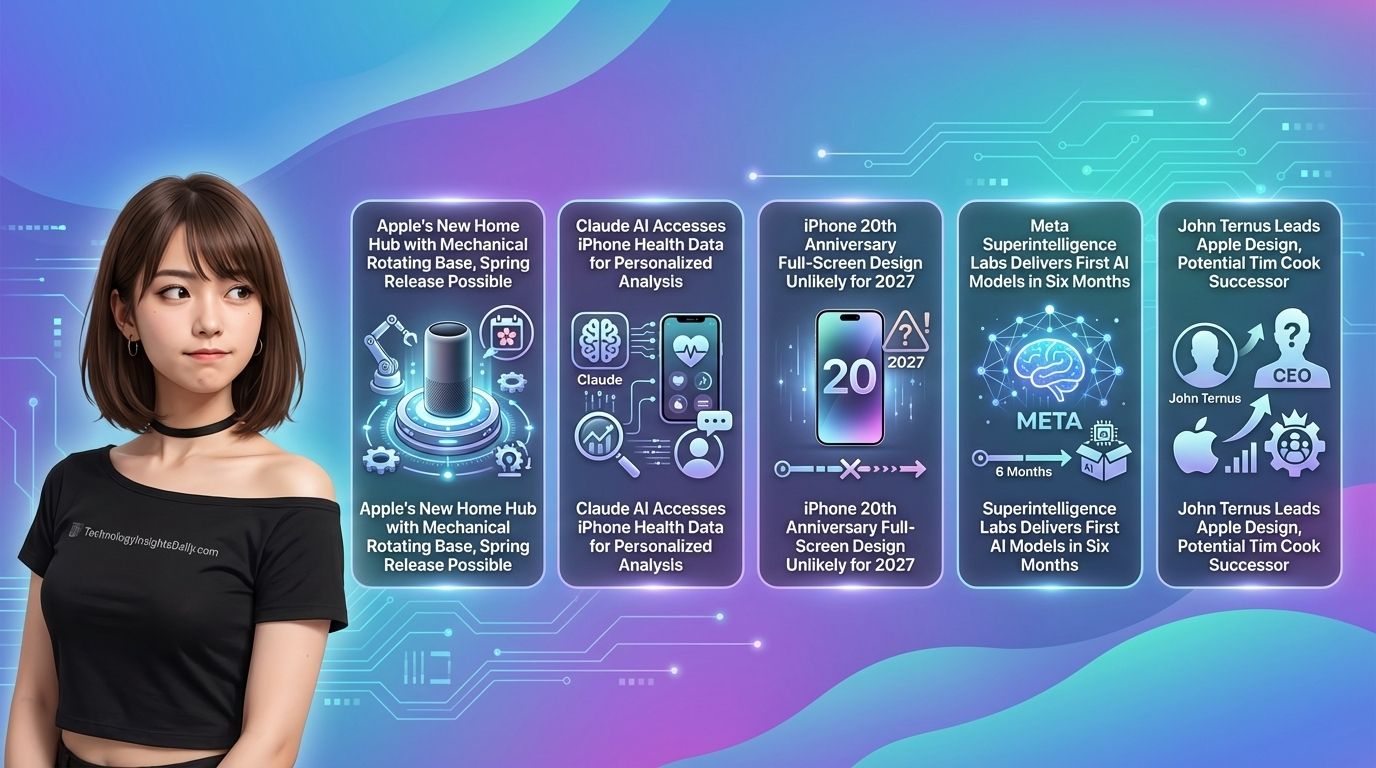
Apple is reportedly gearing up to release its long-anticipated smart Home Hub device as early as spring 2026, this time with a standout design feature: a mechanical rotating (robotic) base that can orient the screen toward users. The hub, which has been delayed from earlier launch windows, is expected to function as a central command center for HomeKit devices while also integrating AI and voice interaction. The swiveling base would set it apart from typical static smart displays, potentially improving visibility and personalization in shared spaces like living rooms or kitchens. Along with display, speakers, and AI capabilities, the product may showcase Apple’s vision of ambient computing—where the hub proactively anticipates needs and adapts to users. While exact pricing and full specs aren’t confirmed yet, the new hub could represent Apple’s first major smart home device beyond HomePod speakers.

Anthropic’s Claude AI chatbot is rolling out Apple Health integration on iPhone, giving the model secure direct access to a user’s health and fitness data. This new capability allows Claude to interpret metrics like step counts, heart rate trends, and workout history, and then generate tailored health insights or recommendations—turning raw numbers into human-friendly context. The feature is starting as a beta and may require users to explicitly grant permissions, but once enabled, Claude can help answer questions about personal well-being, create summaries that make sense of long-term patterns, and potentially guide conversations around fitness goals. This move illustrates how AI tools are shifting from generic chat agents to personalized digital assistants that understand the individual’s real-world data. While this integration offers rich possibilities, users should also consider privacy and security settings; Anthropic emphasizes that such access is opt-in and protected.

Apple’s flagship 20th anniversary iPhone, expected in 2027, might not achieve the all-screen design enthusiasts hoped for. While earlier rumors hinted at a bezel-less display with no notch—potentially redefining iPhone aesthetics—recent reports suggest technical and production challenges could delay that vision. Complex manufacturing requirements for embedding under-display cameras and Face ID components have made a truly uninterrupted screen difficult to bring to market on schedule. Instead, the Anniversary model may see more moderate design refinements or a slightly smaller notch, with the most ambitious screen vision pushed further into the future. This shift underscores the difficulty of balancing cutting-edge hardware innovation with Apple’s high quality standards; similar hurdles reportedly affected Apple’s push into smart home hubs. Even without a fully seamless display, the 2027 iPhone still marks an important milestone and will likely showcase top-tier performance and cameras.
Meta’s newly established Superintelligence Labs—created to accelerate the company’s AI research—has already produced its first internally developed AI models within just six months of formation. According to Meta’s CTO, these early models (codenamed internally but not publicly detailed) represent foundational progress toward more advanced AI technologies that could eventually power consumer products and services. This milestone arrives alongside leadership reshuffles and a renewed strategic focus on reclaiming relevance after mixed reactions to earlier models like Llama 4. While internal deployment is only the first step, the labs’ early productivity shows Meta’s determination to emerge as a serious contender in deep AI research, challenging rivals in foundational models and generative systems. The work also ties into broader Meta ambitions, such as AI-enhanced experiences for its social platforms and devices like Ray-Ban smart glasses. Commercial availability and product integration timelines remain uncertain, but internal delivery suggests momentum.

Apple has quietly expanded John Ternus’ leadership role by giving him oversight of the company’s renowned design teams in addition to his hardware engineering duties. This move elevates Ternus—already a key figure behind products like the iPhone and Mac—to a broader influence over both how Apple devices function and how they look and feel. Industry observers interpret this as a sign Ternus could be in Tim Cook’s succession discussions, given the rarity of such cross-functional authority at Apple. Ternus has been with Apple for years and is respected for his deep technical expertise and product intuition. Steering design as well as engineering signals confidence from existing leadership and offers him exposure to more strategic decision-making. Succession speculation has swirled for some time, with analysts suggesting Apple may eventually groom a successor internally; this expanded role bolsters Ternus’ visibility as a leading candidate.
If this issue made you pause, think, or feel a little more “caught up,” then it did its job. I’m glad you’re here.
This newsletter grows best through people, not algorithms. If you know someone who’d enjoy it, forward this issue, share it, or invite a friend to subscribe.
Every referral helps keep this focused, independent, and worth writing—day after day.
Talk again tomorrow 👋