- Technology Insights Daily
- Posts
- “Avengers: Doomsday” releases first trailer, Chris Evans returns as Captain America
“Avengers: Doomsday” releases first trailer, Chris Evans returns as Captain America

Technology Insights Daily
January 02, 2026
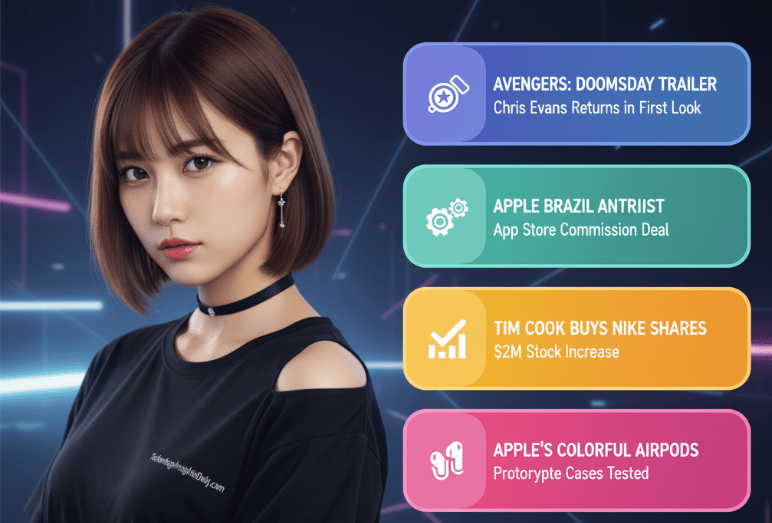
I didn’t start TechnologyInsightsDaily to chase headlines—I started it because I kept asking friends the same question: “Did you see what this actually means?”
Tech moves fast, but understanding it takes intention. Every issue is written the way I’d explain things over coffee—what matters, why it matters, and what’s quietly changing beneath the surface.
If you’re here because you want clarity, not noise, you’re exactly who I write this for.

Marvel Studios has officially unveiled the first trailer for Avengers: Doomsday, igniting massive fan discussion across social media. The biggest surprise is the confirmed return of Chris Evans, once again associated with the Captain America legacy after his emotional farewell in Avengers: Endgame. While Marvel has not clarified whether Evans reprises Steve Rogers directly or appears in an alternate timeline or multiverse role, the trailer leans heavily into darker themes, higher stakes, and large-scale conflict. The film appears positioned as a key turning point for the Marvel Cinematic Universe, potentially unifying fragmented storylines from recent phases. Industry analysts believe Evans’ return is part of Marvel’s broader strategy to re-energize longtime fans while bridging legacy characters with a new generation of heroes. With a more ominous tone and multiverse implications, Avengers: Doomsday signals a dramatic escalation for the franchise.
Apple has agreed to settle an antitrust investigation in Brazil that focused on App Store policies, particularly commission fees and restrictions on alternative payment systems. As part of the agreement, Apple will make adjustments allowing greater flexibility for developers, including revised commission structures for certain categories and clearer communication around external payment options. Brazilian regulators argued that Apple’s previous policies limited competition and placed excessive costs on app developers, especially smaller businesses. While Apple continues to defend its App Store model globally, this settlement reflects growing regulatory pressure worldwide, similar to actions in the EU and South Korea. The company emphasized that user security and privacy remain core priorities, even as it adapts its business practices to meet local legal requirements. The Brazil settlement may serve as a reference point for future negotiations in other regions seeking similar concessions from Apple.

Tim Cook, Apple’s CEO and a long-time Nike board member, has strengthened his investment in Nike with a $3 million stock purchase. The move comes as Nike navigates a period of strategic restructuring, supply chain optimization, and renewed focus on direct-to-consumer sales. Cook’s increased stake is widely interpreted as a signal of confidence in Nike’s long-term strategy, particularly as the company expands its digital ecosystem and data-driven retail operations. His involvement with Nike dates back years, and the relationship between Apple and Nike has historically been close, including collaborations like Apple Watch Nike editions. While the purchase does not indicate any new partnership announcements, it reinforces Cook’s personal belief in the brand’s recovery and innovation potential. Market watchers note that executive stock purchases often send a positive signal to investors during transitional periods for major consumer brands.

Newly surfaced information reveals that Apple experimented internally with AirPods charging cases in a range of bright and vibrant colors, departing from the company’s long-standing preference for white and neutral tones. These prototype designs reportedly included bold hues similar to those used in past iPhone and iMac color lineups. Despite the testing phase, Apple ultimately chose not to release the colorful cases, likely due to branding consistency, manufacturing complexity, and cost considerations. Apple has traditionally favored minimalist aesthetics for its accessories, positioning AirPods as universally recognizable products. However, the existence of these prototypes suggests Apple continues to explore more expressive designs behind the scenes. As competitors increasingly offer customizable earbuds and cases, Apple may revisit color options in future generations. The prototypes highlight Apple’s internal design process, where many concepts are tested extensively even if they never reach consumers.

Apple’s next-generation Apple TV 4K is now expected to launch in spring 2026, later than previously anticipated. According to reports, the device will feature the A17 Pro chip, bringing console-level performance improvements for gaming, smoother user interfaces, and enhanced AI-driven features. The addition of Wi-Fi 7 support would significantly boost wireless speeds and reduce latency, especially for high-resolution streaming and cloud gaming. Apple’s decision to delay the update may be tied to broader hardware scheduling priorities and efforts to align tvOS features with more powerful silicon. While the Apple TV remains a niche product compared to iPhone or iPad, it plays an important role in Apple’s ecosystem strategy, integrating services like Apple Arcade, Fitness+, and Apple TV+. The upcoming refresh suggests Apple still sees long-term value in the living-room experience.
If this issue helped you think differently—even for a minute—consider supporting this work.
Paid subscribers make it possible for me to keep digging, filtering, and writing with independence and care.
👉 Upgrade to paid to unlock deeper insights
📩 Forward this to a friend who loves smart tech takes
🔗 Share or refer someone who hates missing what’s next
Your support keeps this newsletter thoughtful, focused, and human. Thank you for being here ❤️